



Advertisement
Advertisement
Key Points
The International Monetary Fund has revised its 2025 U.S. growth forecast to 1.8%, a reduction of 0.9 percentage point from its January prediction.
“The April 2 Rose Garden announcement necessitated a rapid overhaul of our nearly finalized projections, compressing a production process typically spanning over two months into under 10 days,” stated the IMF’s chief economist, Pierre-Olivier Gourinchas.
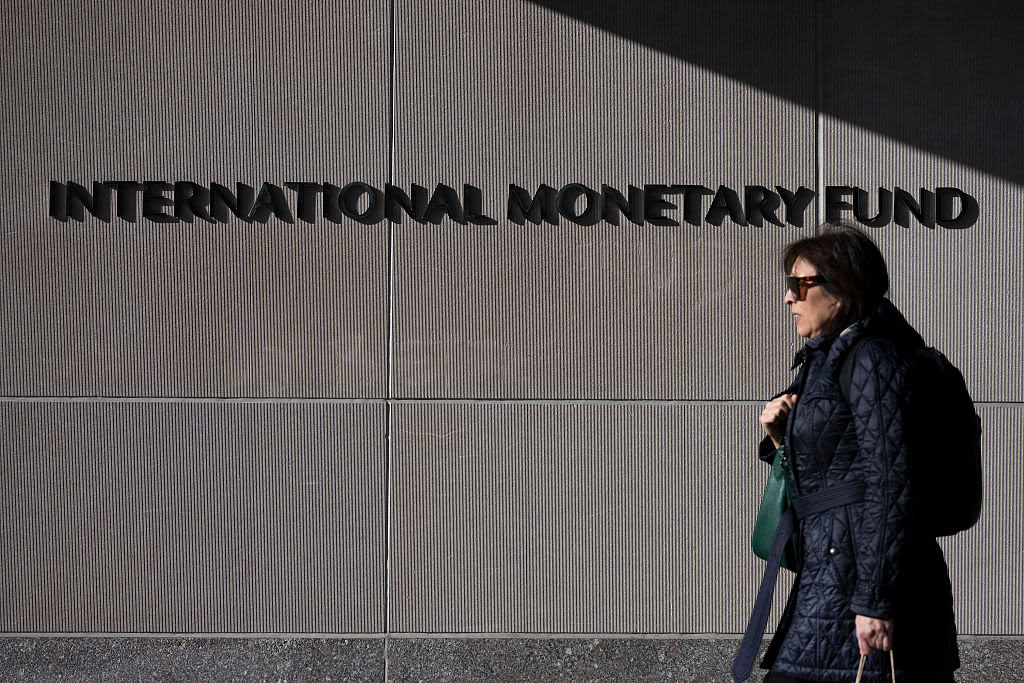
A woman walks past the International Monetary Fund ahead of the International Monetary Fund/World Bank Spring Meetings in Washington, DC, on April 17, 2025.
Jim Watson | AFP | Getty Images
Tariffs are generating significant obstacles for both the U.S. and global economies, prompting the International Monetary Fund to reduce its 2025 growth forecast.
In its latest projections, the IMF now anticipates a 1.8% growth rate for the U.S. in 2025, marking a 0.9 percentage point decrease from its January forecast.
This projection forms part of the IMF’s “reference forecast” for global economic expansion and inflation, relying on data available as of April 4, which includes the U.S.’s “reciprocal” tariffs but excludes later developments like the 90-day pause on higher rates and the exemption on smartphones. This forecast updates the IMF's earlier outlook shared in January.
“This alone represents a significant negative shock to growth,” the IMF noted in the executive summary of its April 2025 World Economic Outlook.
In addition to trade policy challenges, the IMF’s chief economist, Pierre-Olivier Gourinchas, mentioned that declining consumer confidence and consumption indicators also contributed to the downward revision.
Although not predicting a recession in the U.S. yet, Gourinchas informed reporters on Tuesday that the IMF now estimates the chances of a recession at 40%, up from 25% in October 2024.
The IMF also reduced its global growth forecast to 2.8% in 2025, a decrease of 0.5 percentage point from its previous estimate.
“The April 2 Rose Garden announcement compelled us to abandon our projections — nearly finalized at that stage — and compress a production cycle that usually extends beyond two months into under 10 days,” Gourinchas wrote in the April report.
“The common factor ... is that tariffs act as a negative supply shock for the economy imposing them,” he stated.
Higher inflation forecasts for advanced economies
The IMF also adjusted its predictions for headline inflation in advanced economies, including the U.S., the United Kingdom, and Canada, to 2.5% for 2025, indicating an increase of 0.4 percentage point from January’s forecast.
The U.S. inflation forecast was similarly revised upward to 3%, an increase of 1 percentage point from the initial projection in January.
“For the United States, this reflects persistent price dynamics in the services sector, as well as a recent rise in the price growth of core goods (excluding food and energy) and the supply shock from recent tariffs,” the IMF noted in its April report.
The rise in inflation for major economies was counterbalanced by downward revisions in certain emerging markets and developing economies.
The degree to which tariffs influence central banks’ efforts to lower inflation depends “on whether the tariffs are perceived to be temporary or permanent,” according to the IMF’s report.
Past episodes of market volatility have caused the U.S. dollar to strengthen relative to other currencies, creating upward inflationary pressure in other countries. However, the dollar has reversed this trend amid the recent market sell-off.
“The effect of tariffs on exchange rates is not straightforward,” per Gourinchas. “In the medium term, the dollar may depreciate in real terms if tariffs lead to lower productivity in the U.S. tradables sector compared to its trading partners.”
Get Your Ticket to Pro LIVE
Join us at the New York Stock Exchange!
Facing uncertain markets? Gain an advantage with CNBC Pro LIVE, an exclusive, inaugural event at the historic New York Stock Exchange. In today’s dynamic financial landscape, access to expert insights is crucial. As a CNBC Pro subscriber, we invite you to join us for our first exclusive, in-person CNBC Pro LIVE event at the iconic NYSE on Thursday, June 12.
Participate in interactive Pro clinics led by our Pros Carter Worth, Dan Niles, and Dan Ives, with a special edition of Pro Talks featuring Tom Lee. You’ll also have the opportunity to network with CNBC experts, talent, and other Pro subscribers during an exciting cocktail hour on the legendary trading floor. Tickets are limited!
Don’t miss these insights from CNBC PRO
What Nvidia’s earnings mean for the stock market and AI trade
Josh Brown says if Apple announced a deal with Perplexity AI, the shares would hit a record
Challenging Buffett: Buying wonderful companies at fair prices isn’t more profitable
Best Stocks: The value name with one of the best long-term charts Josh Brown has ever seen
Advertisement
Advertisement


Advertisement


