



Advertisement
Advertisement
If the AI industry had its own version of the recording industry's "song of the summer"—a hit that becomes ubiquitous during the warmer months in the Northern Hemisphere—then Alibaba's Qwen Team would undoubtedly take that honor.
In just the last week, the frontier model AI research division of this Chinese e-commerce giant has launched not one, not two, not three, but four (!!) new open-source generative AI models that are setting new records, outperforming even some top proprietary models.
Last night, Qwen Team concluded this series of releases with Qwen3-235B-A22B-Thinking-2507, an updated reasoning large language model (LLM). This model takes longer to respond than non-reasoning or "instruct" LLMs, as it engages in "chains-of-thought" processes, self-reflection, and self-checking, aiming to provide more accurate and comprehensive responses to complex tasks.
Indeed, the new Qwen3-Thinking-2507, as we’ll refer to it briefly, now leads or closely follows the top-performing models across several major benchmarks.
AI Scaling Hits Its Limits
Power caps, rising token costs, and inference delays are reshaping enterprise AI. Join our exclusive salon to discover how top teams are:
Turning energy into a strategic advantage
Architecting efficient inference for real throughput gains
Unlocking competitive ROI with sustainable AI systems
Secure your spot to stay ahead: https://bit.ly/4mwGngO
As AI influencer and news aggregator Andrew Curran wrote on X: “Qwen’s strongest reasoning model has arrived, and it is at the frontier.”
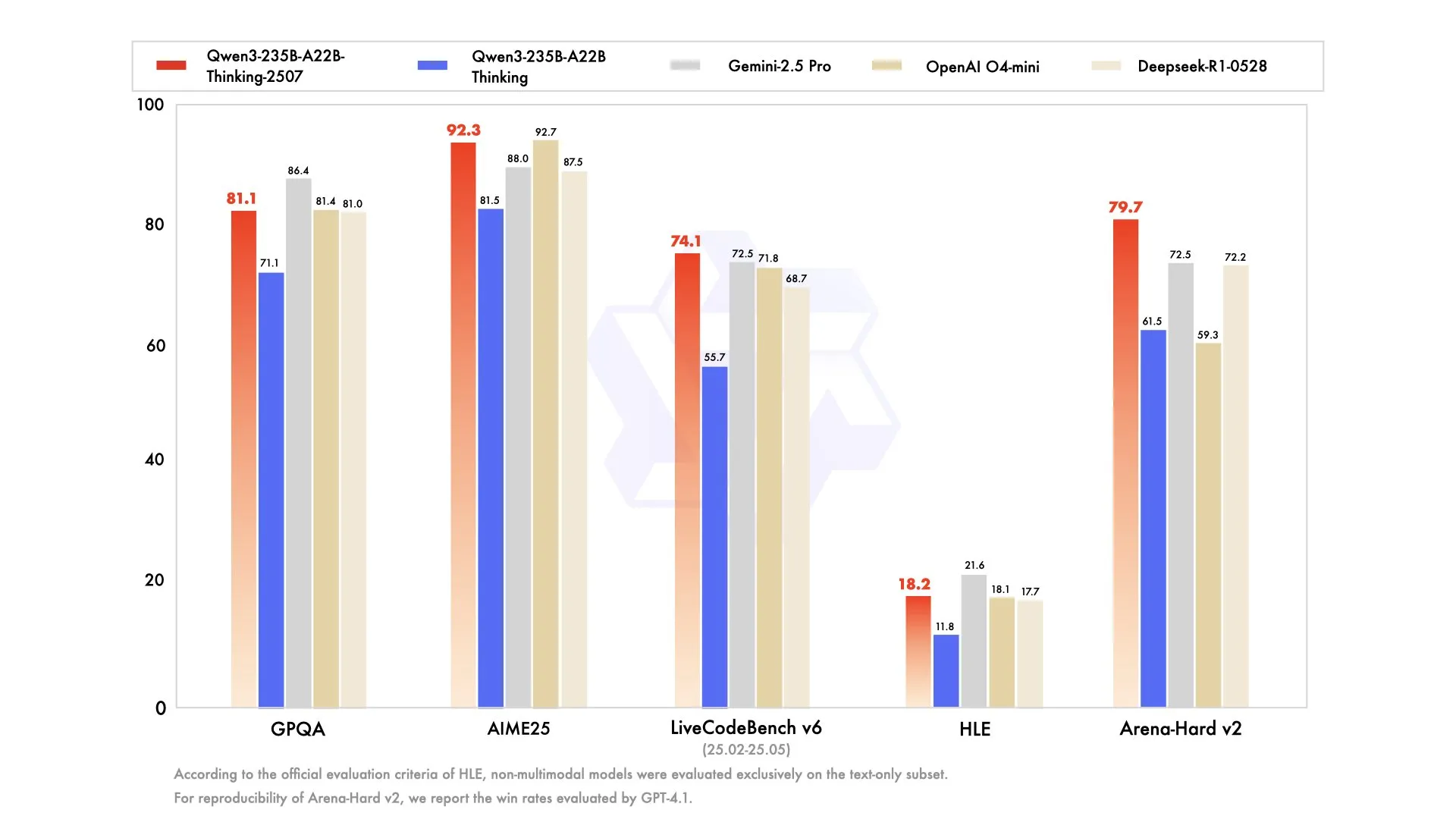
In the AIME25 benchmark—crafted to assess problem-solving abilities in mathematical and logical contexts—Qwen3-Thinking-2507 leads all reported models with a score of 92.3, narrowly surpassing OpenAI’s o4-mini (92.7) and Gemini-2.5 Pro (88.0).
The model also exhibits a dominant performance on LiveCodeBench v6, scoring 74.1, ahead of Google Gemini-2.5 Pro (72.5), OpenAI o4-mini (71.8), and significantly outshining its previous version, which scored 55.7.
In GPQA, a benchmark for graduate-level multiple-choice questions, the model achieves 81.1, nearly equaling Deepseek-R1-0528 (81.0) and trailing Gemini-2.5 Pro’s leading score of 86.4.
On Arena-Hard v2, which evaluates alignment and subjective preference through win rates, Qwen3-Thinking-2507 scores 79.7, positioning it ahead of all competitors.
The results indicate that this model not only surpasses its predecessor in every major category but also sets a new standard for what open-source, reasoning-focused models can accomplish.
A shift away from ‘hybrid reasoning’
The release of Qwen3-Thinking-2507 signifies a broader strategic shift by Alibaba’s Qwen team: moving away from hybrid reasoning models that required users to manually switch between “thinking” and “non-thinking” modes.
Instead, the team is now developing separate models for reasoning and instruction tasks. This separation allows each model to be optimized for its specific purpose—resulting in enhanced consistency, clarity, and benchmark performance. The new Qwen3-Thinking model fully embodies this design philosophy.
Alongside it, Qwen launched Qwen3-Coder-480B-A35B-Instruct, a 480B-parameter model crafted for complex coding workflows. It supports 1 million token context windows and surpasses GPT-4.1 and Gemini 2.5 Pro on SWE-bench Verified.
Additionally, they announced Qwen3-MT, a multilingual translation model trained on trillions of tokens across over 92 languages. It supports domain adaptation, terminology control, and inference from just $0.50 per million tokens.
Earlier in the week, the team released Qwen3-235B-A22B-Instruct-2507, a non-reasoning model that exceeded Claude Opus 4 on several benchmarks and introduced a lightweight FP8 variant for more efficient inference on constrained hardware.
All models are licensed under Apache 2.0 and are accessible via Hugging Face, ModelScope, and the Qwen API.
Licensing: Apache 2.0 and its enterprise advantage
Qwen3-235B-A22B-Thinking-2507 is distributed under the Apache 2.0 license, a highly permissive and commercially friendly license that allows enterprises to download, modify, self-host, fine-tune, and integrate the model into proprietary systems without restriction.
This is in contrast to proprietary models or research-only open releases, which often require API access, impose usage limits, or prohibit commercial deployment. For compliance-conscious organizations and teams aiming to manage cost, latency, and data privacy, Apache 2.0 licensing offers complete flexibility and ownership.
Availability and pricing
Qwen3-235B-A22B-Thinking-2507 is now available for free download on Hugging Face and ModelScope.
For enterprises that lack the resources or capability to host model inference on their own hardware or virtual private cloud, Alibaba Cloud’s API, vLLM, and SGLang provide alternatives.
Input price: $0.70 per million tokens
Output price: $8.40 per million tokens
Free tier: 1 million tokens, valid for 180 days
Integration and tooling
The model is compatible with agentic frameworks via Qwen-Agent and supports advanced deployment through OpenAI-compatible APIs.
It can also be run locally using transformer frameworks or integrated into development stacks via Node.js, CLI tools, or structured prompting interfaces.
Optimal sampling settings for performance include temperature=0.6, top_p=0.95, and max output length of 81,920 tokens for complex tasks.
Enterprise applications and future outlook
With its robust benchmark performance, long-context capability, and permissive licensing, Qwen3-Thinking-2507 is particularly well-suited for use in enterprise AI systems involving reasoning, planning, and decision support.
The broader Qwen3 ecosystem—including coding, instruction, and translation models—further extends its appeal to technical teams and business units looking to incorporate AI across verticals such as engineering, localization, customer support, and research.
The Qwen team’s decision to release specialized models for distinct use cases, supported by technical transparency and community support, signals a deliberate shift toward building open, performant, and production-ready AI infrastructure.
As more enterprises seek alternatives to API-gated, black-box models, Alibaba’s Qwen series increasingly positions itself as a viable open-source foundation for intelligent systems—offering both control and capability at scale.
Advertisement
Advertisement


Advertisement


