



Advertisement
Advertisement
The field of medicine is one of the most rigorously regulated globally, and rightly so—executing a procedure correctly versus incorrectly can mean the difference between life and death.
Consider the multitude of individuals involved in hospital care: not only doctors and nurses but also the entire support staff responsible for managing patient records, equipment, and medical waste disposal. It's crucial for everyone to adhere to the guidelines and best practices to maintain a safe and healthy environment for work, administration, and care delivery. However, each role and department has its own set of guidelines and best practices, often isolated in various applications like SharePoint, SmartVault, Docuware, and others.
For the New York City AI startup C8 Health, this disconnect isn't merely an inconvenience—it's a $345 billion issue.
"When I started practicing medicine, I was stunned at how challenging it was to access the necessary information," stated Dr. Ido Zamberg, an anesthesiologist and C8’s Chief Medical Officer, during a recent video call interview with VentureBeat. "In such a knowledge-intensive field, it seemed absurd to sift through 10 or 15 different systems just to get an answer."
AI Scaling Hits Its Limits
Power caps, rising token costs, and inference delays are reshaping enterprise AI. Join our exclusive salon to discover how top teams are:
Turning energy into a strategic advantage
Architecting efficient inference for real throughput gains
Unlocking competitive ROI with sustainable AI systems
Secure your spot to stay ahead: https://bit.ly/4mwGngO
The New York-based startup, initially focused on providing anesthesiologists with essential knowledge, is now betting on its AI-driven chatbot and knowledge platform to streamline clinical best practices and solve the problem.
"Our platform ensures that knowledge is readily accessible—whether on mobile, desktop, or within the Electronic Medical Records (EMR)—so clinicians don't waste time navigating 20 different systems," said CEO and co-founder Galia Rosen Schwarz in the same interview.
Supported by a fresh $12 million Series A funding round led by Team8, with participation from 10D and Vertex Ventures, the company aims to scale up deployments and expand its reach across the U.S. healthcare system.
Funding to expand
The newly announced funding increases C8 Health’s total raised to $18 million.
Rosen Schwarz mentioned that the funds will be used to grow the team, refine the product, and meet the increasing demand from hospital systems seeking a more effective way to uphold their care standards.
Founded in 2022, the company is focused on one of healthcare's most persistent challenges: ensuring that evidence-based best practices reach those delivering care, regardless of whether they're on a night shift, rotating from another facility, or beginning their residency.
"In many hospitals, protocols are still printed and taped to walls," said Zamberg. "Stakeholders know that no one has time to sift through software to find them. It's that rudimentary."
Zamberg, a trained physician and former software engineer, developed the initial version of C8 Health as a solution to this challenge in his own department. However, he and the company’s other leaders recognized that the problem extended far beyond the anesthesiology department.
As Rosen Schwarz noted: “I interviewed over 100 health professionals in the U.S. and Switzerland, and it became evident how significant this issue was—the impact on both providers and patients was undeniable.”
It's not surprising then that C8’s application rapidly spread, initially to 13,000 employees across five hospitals in Switzerland, and subsequently to over 100 hospitals across the U.S., with clients including Dartmouth Health, Mount Sinai, MetroHealth, and the University of Texas Medical Branch.
A Red Panda avatar provides suggestions without prompting
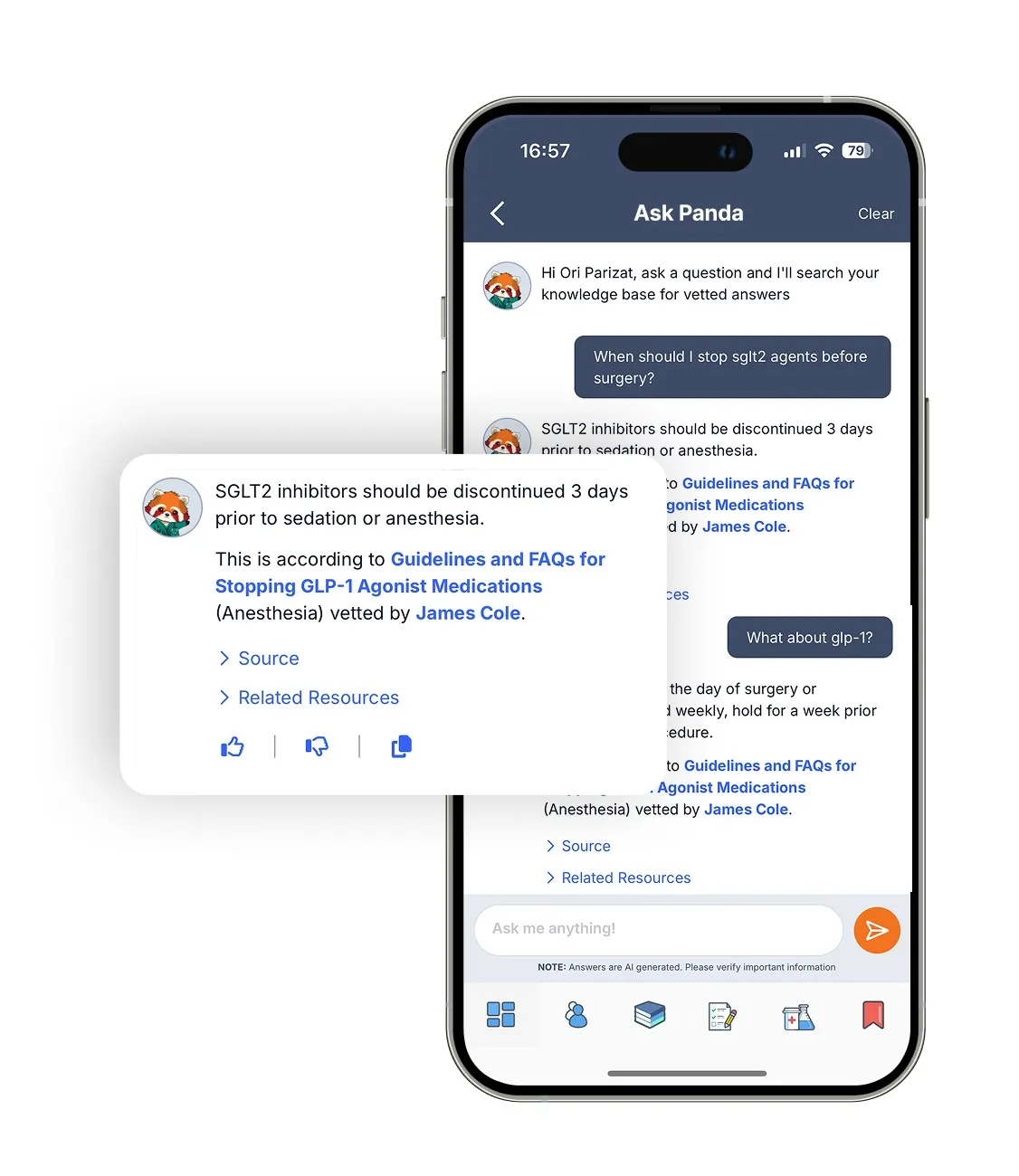
C8 Health’s platform seeks to centralize all clinical guidance—policies, protocols, guidelines, educational materials—and make it instantly accessible in a format customized to the clinician’s role, department, and even daily schedule.
The system is available on mobile, desktop, and directly within EMRs, allowing hospital staff to interact with it seamlessly during their work. A friendly red panda avatar delivers knowledge from the organization’s isolated databases, complete with citations to the underlying sources, files, and documents.
The system doesn’t merely wait for user queries. By analyzing behavioral patterns, schedule data, and institutional context, it can proactively present relevant protocols before a scheduled procedure or offer targeted quality reminders if an individual’s performance metrics are declining.
“We don’t just let users search,” Rosen Schwartz explained. “We actively deliver the right content to the right person, at the right time—based on their role, behavior, and what others in similar roles are doing.”
Early impact earns rave reviews
In each deployment, the company reports clinician adoption rates above 90% within three to six months—a remarkable achievement in a sector where new software tools often struggle to gain traction.
At MetroHealth, Dr. Luis Tollinche, Chair of Anesthesiology, described the state of affairs before C8 as a chaotic mix of six different protocol locations—email threads, shared drives, and policy databases among them.
“We had protocols scattered across six different locations—emails, shared drives, policy databases, even cognitive aids in the EHR,” he wrote in a quote provided to VentureBeat by C8. “When clinicians needed guidance, they often couldn’t remember where to find it, or simply gave up trying. We needed a single, reliable source that made our best practices instantly accessible at the point of care.”
After deployment, over 750 knowledge items were centralized, daily engagement reached 3.49 views per user, and nearly 90% of that activity came from mobile devices.
Real-time feedback and performance tracking
One of C8’s defining features is its ability to integrate performance data into the same interface clinicians use to access knowledge.
Through dashboards and metrics linked to specific procedures, users can see how their performance measures up against departmental goals—and receive guidance to help improve it.
“A clinician can view tomorrow’s cases, the colleagues they’ll work with, relevant best practices, their quality performance, and ways to improve—all in one interface,” Zamberg said.
Dr. Brian Masel, Chief of Pediatric Anesthesiology at UTMB, noted that this kind of real-time, personalized feedback could transform how hospitals approach quality improvement.
Instead of depending on retrospective administrative reports, providers can now engage with their own performance data in real-time, with clear recommendations on how to improve.
Built to handle healthcare’s unique complexities
Unlike generic enterprise software, C8 was developed specifically for the fragmented and time-sensitive environment of modern healthcare. The platform’s backend utilizes general-purpose LLMs, but all data ingestion, cleaning, structuring, and formatting is proprietary—designed to make clinical knowledge easily accessible, trustworthy, and relevant.
“Our assistant distinguishes between a policy, a protocol, educational material, or a national guideline,” said Zamberg. “It’s customized to each user’s role, training level, and department.”
Rosen Schwarz also highlighted the platform's breadth and flexibility: “We built proprietary systems to ingest and structure any type of content—PDFs, videos, scanned docs—so clinicians can get clear, actionable answers without information overload.”
Growth and system integration
With the new funding, C8 plans to deepen its relationships with existing hospital clients and expand to broader system-level deployments.
Dartmouth Health, for instance, is already utilizing the platform to bridge best practices across its main campus and satellite locations.
While the company is currently focused on hospitals, Rosen Schwarz sees clear opportunities to extend the platform into outpatient and urgent care settings, where fragmented access to knowledge remains a significant barrier to consistent care delivery.
“Clinicians need knowledge instantly, often at 3 a.m. in the OR,” she said. “They don’t have time to wonder which app or drive might have the answer—that delay can lead to errors.”
Sarit Firon, Managing Partner at lead investor Team8, remarked that the platform’s traction with clinicians indicates that C8 is addressing a real pain point. In her view, the company is well-positioned to become a foundational layer in how care quality is managed and improved.
As clinical workflows become more complex and staffing more fluid, C8 Health is betting that better access to institutional knowledge isn’t just beneficial—it’s essential.
Advertisement
Advertisement


Advertisement


