



Advertisement
Advertisement
OpenAI is revisiting its origins as an open source AI entity with today’s announcement and the introduction of two new, open source, cutting-edge large language models (LLMs): gpt-oss-120b and gpt-oss-20b.
The first model boasts 120 billion parameters, as its name indicates, and can operate on a single Nvidia H100 graphics processing unit (GPU), while the latter contains 20 billion parameters, making it compact enough to function on a typical consumer laptop or desktop PC.
Both models are text-only language models, which means that unlike the multimodal AI we've seen over the past two years, which allows users to upload files and images for AI analysis, users will be limited to submitting text messages to these models and receiving text responses.
Nonetheless, they can still generate code and solve mathematical problems, and in terms of task performance, they surpass some of OpenAI’s paid models and much of the international competition.
AI Scaling Hits Its Limits
Power constraints, increasing token costs, and inference delays are transforming enterprise AI. Join our exclusive salon to learn how leading teams are:
Leveraging energy as a strategic advantage
Designing efficient inference for real throughput improvements
Achieving competitive ROI with sustainable AI systems
Secure your spot to stay ahead: https://bit.ly/4mwGngO
They can also be linked to external tools such as web search to conduct research for users. More information on this follows.
Most significantly: they’re free, they’re accessible for both enterprises and independent developers to download the code and utilize immediately, allowing modifications to suit their needs, and can be executed locally without internet access, ensuring maximum privacy, unlike other leading OpenAI models and those from prominent U.S.-based competitors like Google and Anthropic.
The models are available for download today with complete weights (the settings that guide their behavior) on the AI code sharing platforms Hugging Face and GitHub.
High benchmark scores
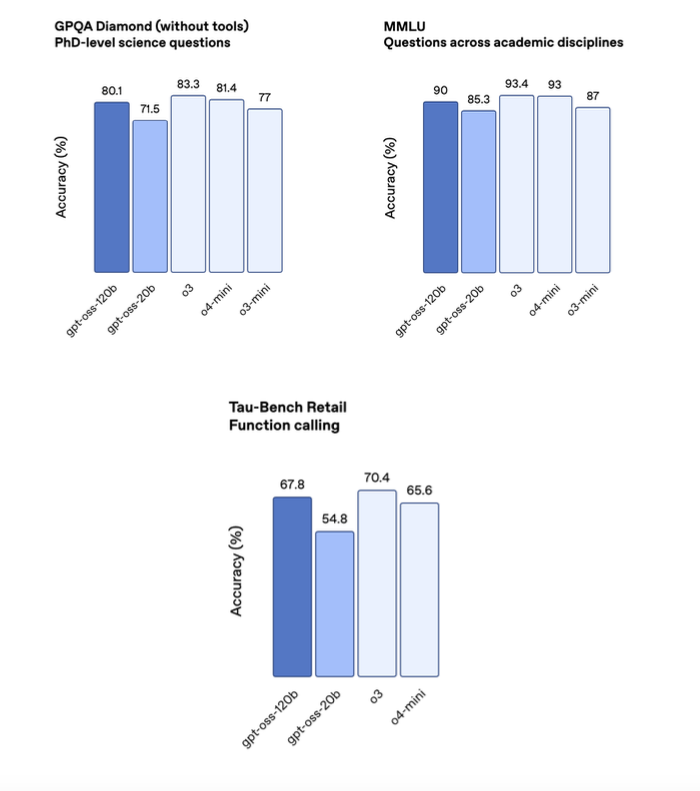
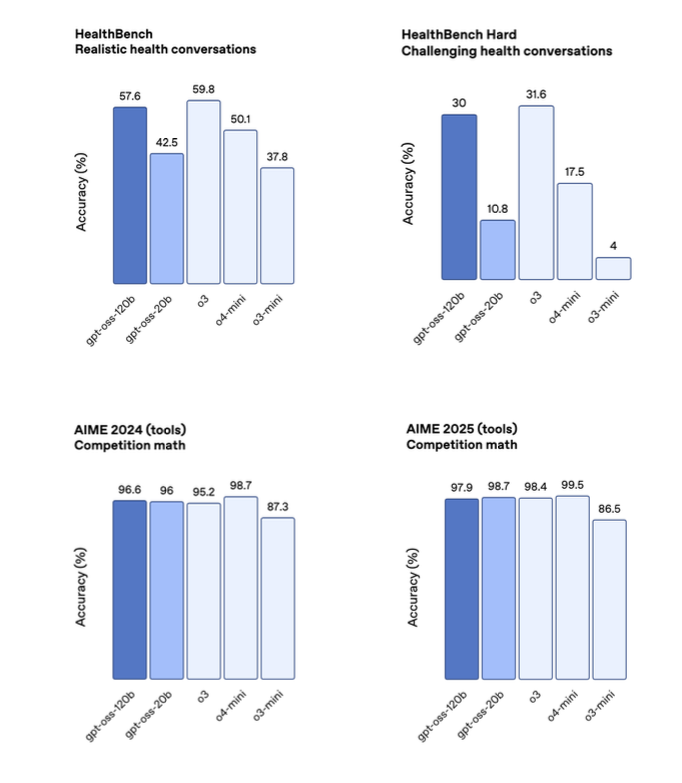
According to OpenAI, gpt-oss-120b matches or exceeds its proprietary o4-mini model on reasoning and tool-use benchmarks, including competition mathematics (AIME 2024 & 2025), general problem solving (MMLU and HLE), agentic evaluations (TauBench), and health-specific evaluations (HealthBench). The smaller gpt-oss-20b model is comparable to o3-mini and even surpasses it in some benchmarks.
The models are multilingual and perform well across various non-English languages, though OpenAI did not specify which or how many.
While these capabilities are available out of the box, OpenAI notes that localized fine-tuning — such as a collaboration with the Swedish government to create a version tailored to the country’s language — can still significantly enhance performance for specific regional or linguistic contexts.
A hugely advantageous license for enterprises and privacy-minded users
The most notable aspect is the licensing terms for both: Apache 2.0, similar to the wave of Chinese open source models released in recent weeks, and a more enterprise-friendly license compared to Meta’s more complex and nuanced open-ish Llama license, which requires that users operating a service with over 700 million monthly active users obtain a paid license to continue using the company’s family of LLMs.
In contrast, OpenAI’s new gpt-oss series of models have no such restrictions. In line with Chinese competitors and counterparts, any consumer, developer, independent entrepreneur, or enterprise large or small is empowered by the Apache 2.0 license to download the new gpt-oss models at will, fine-tune and modify them to fit their specific needs, and use them to generate revenue or operate paid services, all without paying OpenAI anything!
This also allows enterprises to use a powerful, nearly top-tier OpenAI model on their own hardware privately and securely, without sending any data to the cloud, web servers, or elsewhere. For highly regulated sectors like finance, healthcare, and legal services, not to mention organizations in military, intelligence, and government, this may be a necessity.
Before today, anyone using ChatGPT or its application programming interface (API) — the service that acts like a switchboard and allows third-party software developers to connect their apps and services to OpenAI’s proprietary/paid models like GPT-4o and o3 — was transmitting data to OpenAI servers that could technically be subpoenaed by government agencies and accessed without the user’s knowledge. This remains true for anyone using ChatGPT or the API going forward, as OpenAI co-founder and CEO Sam Altman recently cautioned.
While running the new gpt-oss models locally on a user’s own hardware disconnected from the web would ensure maximum privacy, once the user decides to connect it to external web search or other web-enabled tools, some of the same privacy risks and issues might arise — through any third-party web services the user or developer relies on when connecting the models to those tools.
The last OpenAI open source language model was released more than six years ago
“This is the first time we’re releasing an open-weight language model in quite some time… We see this as complementary to our other products,” said OpenAI co-founder and president Greg Brockman during an embargoed press video call with VentureBeat and other journalists last night.
The last time OpenAI released a fully open source language model was GPT-2 in 2019, over six years ago, and three years prior to the release of ChatGPT.
This fact has sparked the ire of — and led to several lawsuits from — former OpenAI co-founder and backer turned rival Elon Musk, who, along with many other critics, have spent the past several years accusing OpenAI of abandoning its mission and founding principles and namesake by opting for paid proprietary models available only to customers of OpenAI’s API or paying ChatGPT subscribers (though there is a free tier for the latter).
OpenAI co-founder and CEO Sam Altman did express regret about being on the “wrong side of history” by not releasing more open source AI sooner in a Reddit AMA (ask me anything) QA with users in February of this year, and Altman committed to releasing a new open source model back in March, but ultimately the company postponed its release from a planned July date until now.
Now OpenAI is steering back toward open source, and the question is, why?
Why would OpenAI release a set of free open source models that it makes no money from?
To paraphrase Jesse Plemons’ character’s memorable line from the film Game Night: “How can that be profitable for OpenAI?”

After all, business for OpenAI’s paid offerings appears to be thriving.
Revenue has soared alongside the rapid growth of its ChatGPT user base, now at 700 million weekly active users. As of August 2025, OpenAI reported $13 billion in annual recurring revenue, up from $10 billion in June. This growth is fueled by a sharp increase in paying business customers — now 5 million, up from 3 million just two months earlier — and surging daily engagement, with over 3 billion user messages sent every day.
The financial momentum follows an $8.3 billion funding round that valued OpenAI at $300 billion and lays the groundwork for the company’s ambitious infrastructure expansion and global ambitions.
In comparison, closed/proprietary rival AI startup Anthropic’s reported $5 billion in total annual recurring revenue, but interestingly, Anthropic is said to be earning more from its API, $3.1 billion in revenue compared to OpenAI’s $2.9 billion, according to The Information.
So, given how well the paid AI business is already performing, the strategy behind these open source offerings is less clear — especially since the new OpenAI gpt-oss models will likely reduce some (potentially a lot of) usage of OpenAI’s paid models. Why revert to offering open source LLMs now when substantial revenue is pouring into paid models, and none will, by its very nature, directly contribute to open source models?
The answer is simple: because open source competitors, starting with the release of the remarkably efficient DeepSeek R1 by the Chinese AI division of the same name in January 2025, are providing performance benchmarks nearly on par with paid proprietary models, for free, with minimal (virtually no) implementation restrictions for enterprises and end users. Increasingly, enterprises are adopting these open source models in production.
As OpenAI executives and team members disclosed to VentureBeat and numerous other journalists on an embargoed video call last night, regarding the new models, when it comes to OpenAI’s API, most customers are using a combination of paid OpenAI models and open source models from other providers. (I inquired, but OpenAI declined to specify what percentage or total number of API customers are using open source models and which ones).
At least, until now. OpenAI clearly hopes these new gpt-oss offerings will persuade more users to switch from competing open source offerings back to OpenAI’s ecosystem, even if OpenAI doesn’t see any direct revenue or data from that usage.
On a larger scale, it appears OpenAI aims to be a comprehensive, one-stop shop AI provider for all of an enterprise, indie developer’s, or regular consumer’s machine intelligence needs — from a clean chatbot interface to an API for building services and apps on top of to agent frameworks for creating AI agents through said API to an image generation model (gpt-4o native image generation), video model (Sora), audio transcription model (gpt-4o-transcribe), and now, open source offerings as well. Can a music generation and “world model” be far behind?
OpenAI seeks to encompass the AI market, proprietary and open source alike, even if the latter holds no direct monetary value.
Training and architecture
Feedback from developers significantly influenced gpt-oss’s design. OpenAI states that the top request was for a permissive license, leading to the adoption of Apache 2.0 for both models. Both models employ a Mixture-of-Experts (MoE) architecture with a Transformer backbone.
The larger gpt-oss-120b activates 5.1 billion parameters per token (out of 117 billion total), and gpt-oss-20b activates 3.6 billion (out of 21 billion total).
Both support 128,000 token context length (equivalent to about 300-400 pages of a novel’s worth of text a user can upload at once), and utilize locally banded sparse attention and employ Rotary Positional Embeddings for encoding.
The tokenizer — the program that converts words and segments of words into the numerical tokens that the LLMs can understand, dubbed “o200k_harmony” — is also being open-sourced.
Developers can choose among low, medium, or high reasoning effort settings based on latency and performance needs. While these models can reason through complex agentic tasks, OpenAI emphasizes they were not trained with direct supervision of CoT outputs, to maintain the observability of reasoning behavior—an approach OpenAI deems important for safety monitoring.
Another common request from OpenAI’s developer community was for robust support for function calling, particularly for agentic workloads, which OpenAI believes gpt-oss now delivers.
The models are engineered for chain-of-thought reasoning, tool use, and few-shot function calling, and are compatible with OpenAI’s Responses API introduced back in March, which allows developers to enhance their apps by connecting an OpenAI LLM of their choice to three powerful built-in tools — web search, file search, and computer use — within a single API call.
But for the new gpt-oss models, tool use capabilities — including web search and code execution — are not tied to OpenAI infrastructure. OpenAI provides the schemas and examples used during training, such as a basic browser implementation using the Exa API and a Python interpreter that operates in a Docker container.
It is up to individual inference providers or developers to define how tools are implemented. Providers like vLLM, for example, allow users to configure their own MCP (Model-Controller-Proxy) server to specify the browser backend.
While these models can reason through complex agentic tasks, OpenAI emphasizes they were not trained with direct supervision of CoT outputs, to maintain the observability of reasoning behavior—an approach OpenAI deems important for safety monitoring.
Safety evaluations and measures
OpenAI conducted safety training using its Preparedness Framework, a document that outlines the procedural commitments, risk‑assessment criteria, capability categories, thresholds, evaluations, and governance mechanisms OpenAI employs to monitor, evaluate, and mitigate frontier AI risks.
These included filtering chemical, biological, radiological, and nuclear threat (CBRN) related data out during pretraining, and applying advanced post-training safety methods such as deliberative alignment and an instruction hierarchy to enforce refusal behavior on harmful prompts.
Advertisement
Advertisement


Advertisement


