



Advertisement
Advertisement
AnyCoder, an open-source web app development platform created by Hugging Face's ML Growth Lead Ahsen Khaliq (@_akhaliq on X), is now available on Hugging Face Spaces.
This tool is accessible to all users of Hugging Face's AI code sharing repository and features live previews, multimodal input, and one-click deployment. It operates in a hosted environment, enabling independent creators with limited technical skills, as well as those developing for clients or large enterprises, to quickly engage in “vibe coding” web apps with the aid of Hugging Face-hosted AI models.
Thus, it serves as an alternative to platforms like Lovable, which also enable users to start coding apps using plain English without requiring formal programming knowledge.
Free vibe coding available to all, powered by Kimi K2
Khaliq developed AnyCoder as a personal initiative within the Hugging Face ecosystem, positioning it as “one of the pioneering vibe coding apps” that supports Moonshot’s efficient and compact Kimi K2 model introduced last week.
AnyCoder’s core functionality lets users input plain-text descriptions to generate HTML, CSS, and JavaScript, which are shown in a live preview pane and can be edited or deployed directly. It also offers example templates for todo apps, dashboards, calculators, and more.
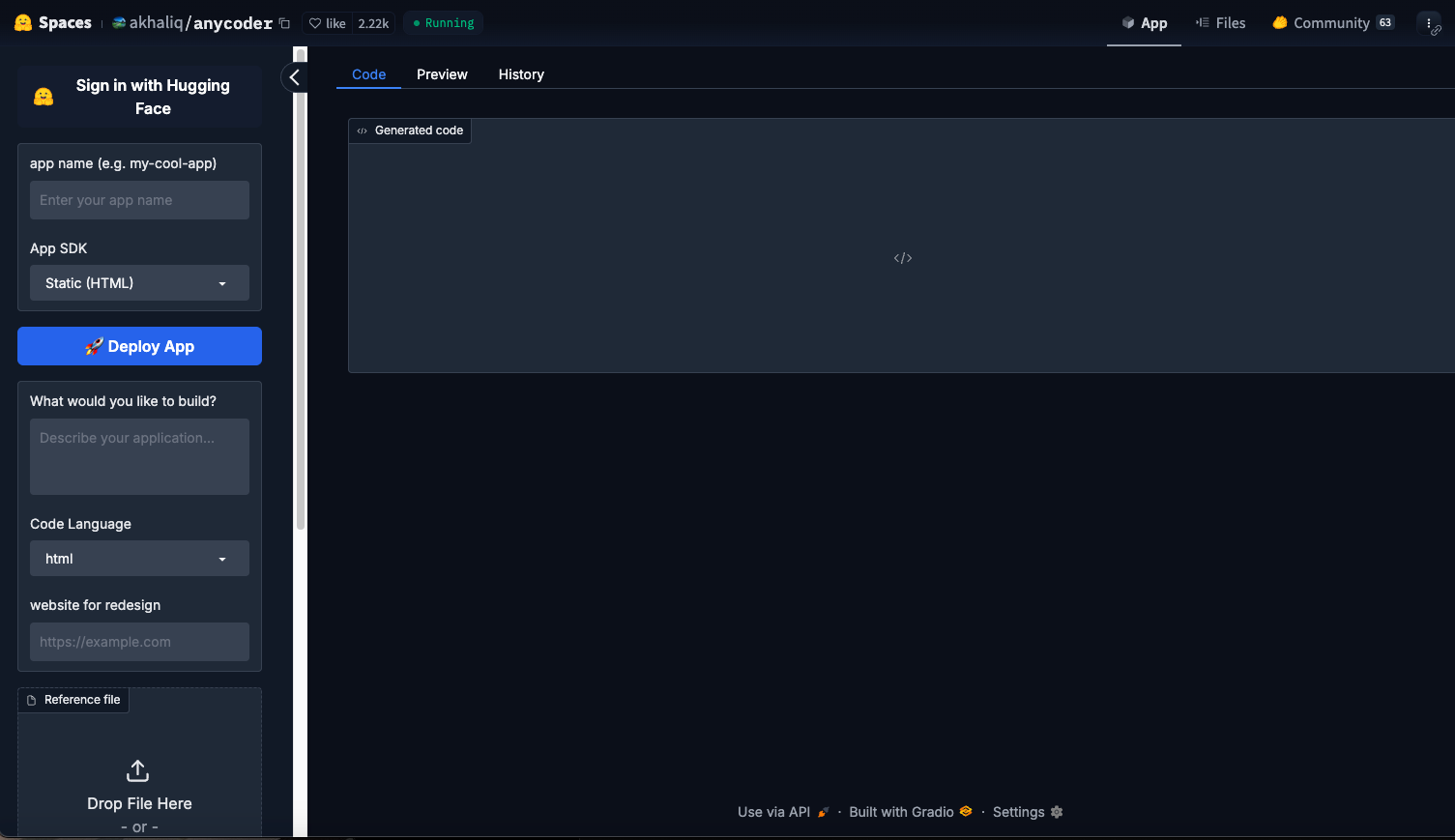
Screenshot of AnyCoder on Hugging Face
Entirely crafted using Hugging Face’s open-source Python development environment Gradio, AnyCoder allows users to describe applications in plain English or upload images to instantly generate functional frontend code.
Khaliq undertook AnyCoder as a personal project within the Hugging Face ecosystem.
In a direct message exchange with this VentureBeat journalist, he described it as a “free open source vibe coding app.”
He also highlighted that the tool supports multiple open source models, allowing users to switch between them via a dropdown menu on the control sidebar on the left pane, including:
Moonshot Kimi-K2
DeepSeek V3
DeepSeek R1
Baidu’s ERNIE-4.5-VL
MiniMax M1
Alibaba’s Qwen3-235B-A22B
SmolLM3-3B
GLM-4.1V-9B-Thinking
Code from UI images, web search integration, and OCR support
With the ERNIE-4.5-VL model, AnyCoder supports multimodal generation. Users can upload UI design screenshots or mockups to generate functional frontend code, making it beneficial for designers or visually-oriented teams.
AnyCoder features a website redesign tool that extracts content from any public site and re-renders it with a more modern layout. It leverages scraped content such as page structure, meta information, and images to construct a new version, optionally guided by user directives like “make it minimalist” or “add dark mode.”
To stay aligned with current design trends and implementation patterns, AnyCoder offers web search integration via Tavily. When activated with an API key, the platform searches for current technologies and best practices before generating code.
Users can upload images containing text—like screenshots or handwritten notes—and AnyCoder extracts that content using Tesseract OCR. The extracted text can then be used in code prompts or app content.
One-click deployment to Hugging Face Spaces
AnyCoder enables immediate deployment of generated apps to Hugging Face Spaces. After authenticating via OAuth and granting necessary permissions, users can deploy apps under their own Hugging Face account namespace. Deployments include:
Mobile-friendly, responsive designs
Branded header/footer and README
Live, shareable URL
Full ownership and edit access
This deployment feature now supports full Python apps built with Gradio, broadening the tool’s applications beyond static sites. Support for Streamlit is also being developed.
For novice developers or even those with technical skills seeking to launch a new project swiftly, AnyCoder seems like an attractive and compelling starting point.

Advertisement
Advertisement
Advertisement


